Facade Lighting Techniques: Wall Washing, Grazing and Accent
A designer's guide to facade lighting techniques, when to wall wash, when to graze, when to silhouette, and how to choose the right strategy for the architecture, the material and the context.
Introduction
Facade lighting is the discipline of making a building read after dark. Done well, it reveals the architecture, respects the neighbourhood, and gives the building a second life at night. Done badly, it flattens the elevation into a floodlit box, spills light into bedrooms across the street, and wastes energy for the fifteen years the fixtures remain on site.
The difference between the two outcomes comes down to technique. There is no universal facade strategy; the material, the geometry, the urban context and the brand each push the decision in a different direction. This guide covers the four core facade lighting techniques (wall washing, grazing, silhouette and accent uplighting), the situations each is designed for, and the technical parameters that separate professional facade lighting from decorative floodlighting.
Read the Building First
Before any technique is chosen, the building is analysed. What is the primary material, and how does it read at close range vs. from across the street? Where are the entry moments, the sculptural elements, the signage? What is the viewing distance, from the pavement, from the road, from a neighbouring building? What is the brand or civic identity the building represents? What are the neighbours, the ordinances, the ecology?
Only after these questions have honest answers should a technique be assigned. Our facade lighting design service begins every project with this reading exercise, because a technique picked before the building is understood almost always undershoots.
The Core Facade Lighting Techniques
| Technique | Best For | Fixture Type | Typical Position |
|---|---|---|---|
| Wall washing | Smooth contemporary surfaces, murals, feature walls | Wall washers with asymmetric optic | 0.3–1.5m from wall, top or bottom |
| Grazing | Stone, brick, textured concrete, timber slats | Linear grazers or narrow-beam spots | 50–200mm from wall, top or bottom |
| Silhouette | Sculptural geometry, screens, jaali, colonnades | Backlight or ground-mounted uplight | Behind the object |
| Uplighting / Accent | Columns, vertical elements, trees adjacent to facade | In-ground uplights, narrow-beam spots | At the base, aimed vertically |
Wall Washing
Wall washing produces a smooth, even wash of light across a flat surface. The fixture, typically a linear luminaire with an asymmetric optic, sits 0.3 to 1.5 metres away from the wall (top or bottom) and throws its beam almost parallel to the surface, filling it from top to bottom in a controlled gradient. Wall washing is the correct technique for smooth contemporary facades, painted murals, backlit signage walls and any elevation where the intent is to reveal the surface as a plane, not as a texture.
Wall washing is the wrong technique for textured stone, exposed brick or timber slats, because the parallel beam eliminates the shadow play that gives those materials their character. On textured surfaces, wall washing looks curiously flat.
Grazing
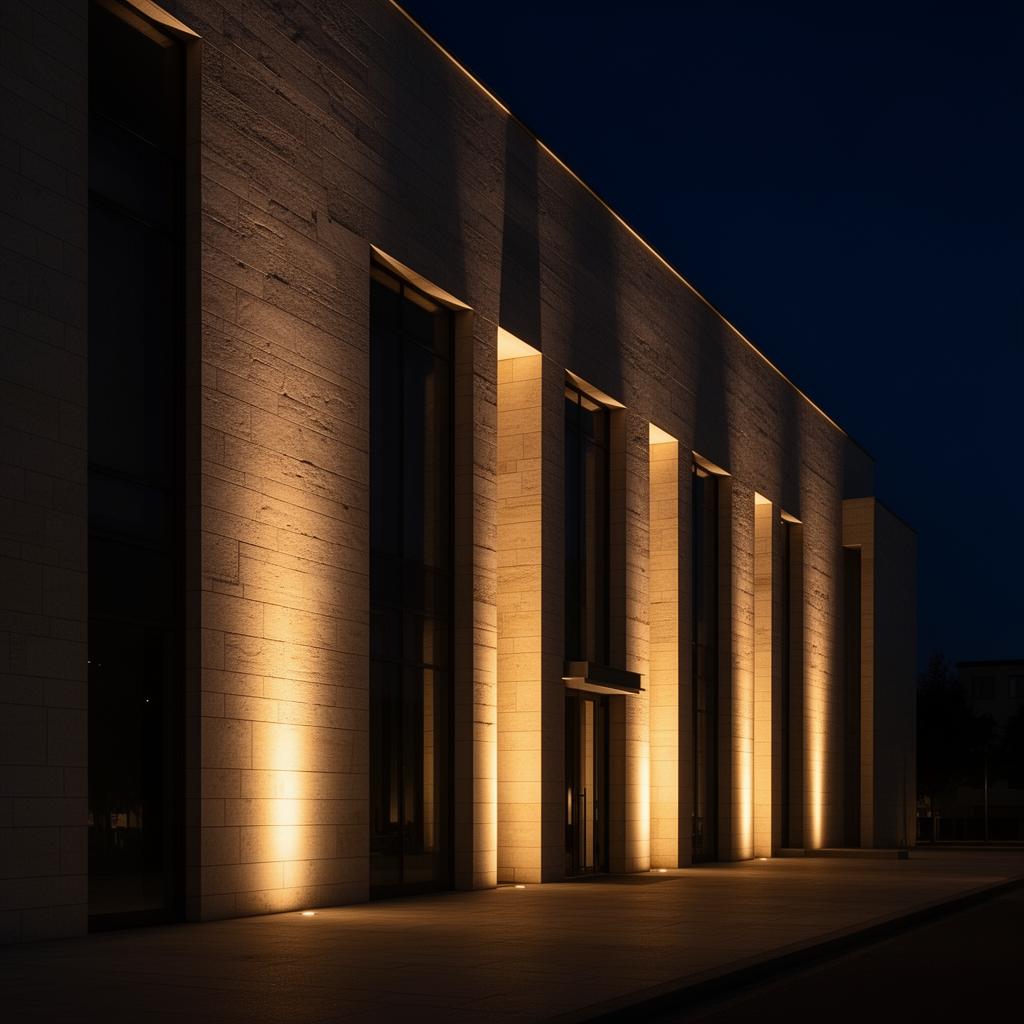
Grazing is wall washing's textural cousin. The fixture sits much closer to the wall (50 to 200 millimetres) and the beam runs almost tangent to the surface. Every joint, ridge, chisel mark and grain becomes a raking shadow. Grazing is the correct technique for stone facades, exposed brick, board-formed concrete, timber cladding, jaali screens and anything where the material texture is itself the design story.
The trade-off is intensity variation; grazed surfaces are always brightest near the fixture and fade with distance. Design the grazing rhythm to match the architecture, not to fight it.
Silhouette
Silhouette lighting places the light source behind the object being lit, rendering the object as a dark shape against a lit backdrop. This technique is powerful for sculptural geometry, decorative screens, jaali walls, colonnades and any element whose profile is more interesting than its surface. A backlit jaali on a Bengaluru heritage facade at 2700K produces a night image of extraordinary depth using very little wattage.
Silhouette works only when the backdrop is clean and continuous. A busy background dilutes the effect.
Uplighting and Accent
Uplighting places in-ground or wall-mounted fixtures at the base of vertical elements (columns, trees, vertical fins, signage totems) and aims narrow beams upward. It is the classic technique for landmarking a hotel entry, a corporate tower entrance or a heritage porch. When combined with the landscape lighting layer, uplights on the facade continue seamlessly into the surrounding trees and pathways. Our landscape lighting design service plans facade uplighting and landscape uplighting as a single continuous composition, because a facade lit in isolation from its garden looks like a stage set.
Accent lighting on the facade is the equivalent of accent lighting inside a room: narrow-beam spots aimed at specific moments, signage, sculptural details, entry doors, at contrast ratios significantly above the base facade illumination.
Heritage vs Contemporary Facades
Heritage facades respond best to warm, restrained lighting: 2700K–3000K, low intensity, no dynamic colour, careful preservation of shadow and mystery. The intent is to reveal, not to spectacle. Contemporary and corporate facades tolerate more contrast, higher intensity and, where the brand justifies it, controlled colour change. Never apply RGB colour change to heritage; it reduces the architecture to an advertising surface.
Light Pollution and Restraint
Professional facade lighting is measured as much by what it does not do as by what it does. Aim downward where possible. Shield the source so the LED chip is never in the direct line of sight. Avoid uplighting that spills into the night sky, disturbs migrating birds or floods the neighbour's bedrooms. Most cities now have dark-sky ordinances; even where they do not, restraint is the mark of professional facade work. Schedule the lighting; there is almost no case for a facade lit at full intensity from dusk to dawn. Our commercial lighting design service programmes corporate facade lighting to curfew at 22:00 or 23:00 in most jurisdictions.
Common Mistakes
- Flood-lit facades that flatten the architecture into a lit rectangle
- RGB colour change on heritage or civic buildings
- Wall washing textured stone, which kills the shadow play
- Grazing smooth surfaces, which produces nothing but hot patches
- Glare directed into adjacent buildings, pavements or roads
- No scheduling, so the facade blazes all night
- Fixtures selected without IP65 rating; monsoon does the rest
Professional Recommendation
A facade lit everywhere reads nowhere. Pick two to four architectural moments, light them with the right technique for their material, schedule the display, and let the rest of the elevation rest. Restraint always wins.
Lighting Intelligence by Alya
At Ashwamedha Design Solutions, this is part of our Lighting Intelligence practice, every recommendation is validated through DIALux simulation, lux calculations and visual comfort analysis before it reaches a construction site. Alya, our lighting intelligence platform, packages this thinking into reusable design tools.
Frequently Asked Questions
What are the main facade lighting techniques?+
Wall washing (smooth even wash on flat surfaces), grazing (raking light that reveals texture on stone, brick or timber), silhouette (backlighting sculptural elements), and uplighting or accent (narrow beams on columns, entries and features).
When should I use wall washing vs grazing?+
Wall washing for smooth surfaces, painted walls, murals and signage. Grazing for textured materials where the shadow play is the point, stone, brick, board-formed concrete, timber cladding and jaali screens.
Should I light my entire facade?+
Rarely. Choosing two to four architectural moments and lighting them well outperforms a uniformly lit elevation. A facade lit everywhere reads nowhere.
Is RGB facade lighting appropriate?+
Only for specific brand-driven or event-driven contemporary buildings. For corporate, civic and any heritage architecture, restraint reads better and ages better.
What IP rating do facade fixtures need?+
IP65 minimum for exposed facade positions, IP66 for splash zones or ground-embedded uplights. IP44 fixtures do not survive Indian monsoons and will fail within seasons.
Should facade lights stay on all night?+
No. Schedule facade lighting to a curfew, typically 22:00 or 23:00, both for energy and to respect dark-sky guidelines. Landmark moments can remain lit at reduced intensity; the full display should not.
Related Service
Facade Lighting Design
See how this thinking is applied on live projects.
Need help applying this to your project?
Our team can review your space and turn these ideas into a measured lighting design.