What is CRI in Lighting? Color Rendering Index Explained
A complete guide to CRI in lighting, what the number measures, why R9 is the hidden specification that matters, and how to specify colour rendering across residential, hospitality and commercial spaces.
Introduction
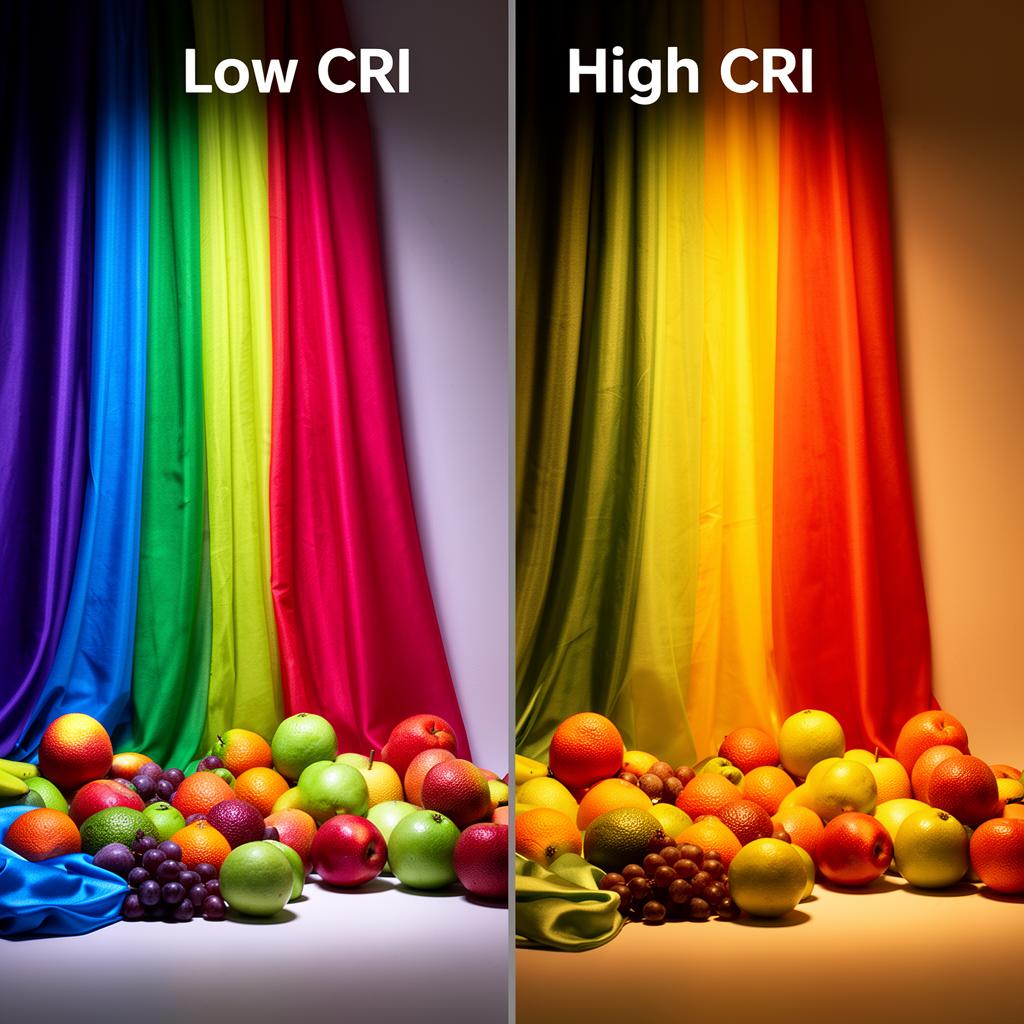
CRI, the Colour Rendering Index, is one of the most quoted and least understood numbers on a lighting datasheet. Every LED spec sheet lists a CRI value. Every supplier claims their product is "high CRI". Very few clients or even architects can explain what the number actually measures, or why two lamps both labelled "CRI 90" can render a wall of teak wood as two completely different materials.
This guide unpacks what CRI is, what it is not, why the R9 value hidden underneath it matters more than most people realise, and how a professional lighting designer specifies colour rendering across residential, hospitality and commercial projects.
What CRI Actually Measures
CRI is a score from 0 to 100 that measures how accurately a light source renders the colour of objects, compared against a reference source of the same colour temperature. That reference is incandescent for warm sources and daylight for cool sources, both of which score a perfect 100 by definition.
A CRI of 100 means the light source reveals colours exactly as the reference would. A CRI of 80 means noticeable colour distortion. A CRI of 50 (typical of old sodium street lamps) means colours are barely readable, everything looks orange-tinged and muddy. The number is an average, and that averaging behaviour is the source of most confusion.
What the Numbers Actually Mean, in Practice
| CRI | Acceptable For | Visible Effect |
|---|---|---|
| 70 | Industrial, warehouse, back-of-house | Colours visibly distorted; wood looks flat, skin looks unwell |
| 80 | General commercial, offices, circulation | Acceptable for utility; not for hospitality or premium retail |
| 90 | Residential, hospitality, premium retail | Colours read naturally; wood, food and fabric look correct |
| 95+ | Galleries, jewellery, high-end photography | Perceptually indistinguishable from reference for most observers |
Why R9 Is the Hidden Specification
The standard CRI value (technically called Ra) is the average score across only eight pastel test colours, labelled R1 through R8. All eight are muted, mid-saturation shades. The saturated red test colour, R9, is not included in the average.
This matters enormously. Saturated red is the colour of skin, wood, meat, fabric, brick, most food, most Indian textiles and every warm interior finish. A lamp with a headline "CRI 90" can have an R9 value of 20 or lower and still legally claim that CRI 90 label. Under such a lamp, skin tones look grey, teak looks lifeless, and food photography is unusable. Always ask for R9 explicitly. The professional benchmark is CRI 90 with R9 > 50, and for hospitality or gallery use we push to R9 > 80.
CRI 90 without R9 verification is a marketing number. CRI 90 with R9 > 50 is a specification.
CRI and CCT Work Together
CRI describes colour accuracy. CCT (colour temperature) describes colour tone. They are two independent axes and both affect how a space reads. A CRI 90 lamp at 3000K and a CRI 80 lamp at 3000K produce the same warm tone, but the CRI 90 lamp reveals depth, grain and undertone in materials that the CRI 80 lamp cannot.
The practical implication: specifying CCT alone is incomplete. Specifying lux alone is incomplete. A residential lighting brief that says "3000K, 200 lux" without a CRI/R9 minimum is asking for disappointment. In our residential lighting design service every fixture on every project is locked to CRI 90+ with R9 > 50 as a baseline, and CCT is chosen room by room.
Where CRI Matters Most
Residential Interiors
Homes are the highest-stakes application of CRI outside a gallery. People spend hours a day under residential lighting and the finishes, wood, stone, upholstery, art, food on the dining table, are the reason clients invested in the interior in the first place. CRI 80 fixtures in a residential ceiling waste that investment by rendering everything as a flatter, cooler version of itself.
Hospitality
Restaurants, hotel guest rooms, spas and lobbies all sell an experience of comfort and quality. Skin tone, food presentation and material warmth are core to that experience. Any hospitality specification below CRI 90 R9 > 50 is a false economy. Our hospitality lighting design service treats CRI as a non-negotiable, on par with lux and glare control.
Commercial and Retail
Commercial applications split into two camps. Utility zones (warehouses, back-of-house, parking) tolerate CRI 80. Client-facing spaces (offices where wellbeing matters, showrooms, retail, meeting rooms) need CRI 90+ minimum. Product-selling environments, particularly for textiles, jewellery, food and cosmetics, benefit from CRI 95 with dedicated R9 optimisation. Our commercial lighting design service tunes CRI zone by zone rather than applying one number building-wide.
How to Verify CRI Claims
Marketing sheets are not evidence. Ask every supplier for the LM-79 test report, which is the internationally recognised photometric test conducted by an accredited lab. The report will show the full R1–R15 breakdown, the CRI (Ra) average, and the R9 value in isolation. Any reputable manufacturer will produce this on request. Any supplier who cannot is either selling a rebadged unknown product or hoping you will not ask.
Common Mistakes
- Specifying lux without specifying CRI
- Accepting a "CRI 90" claim without asking for the R9 value
- Mixing CRI 80 and CRI 90 fixtures on the same wall or ceiling
- Using CRI 80 fixtures in bathrooms with mirrors, then wondering why skin tones look wrong
- Assuming higher CRI always costs dramatically more; the premium is usually 10–20%
Professional Recommendation
Specify CRI 90 with R9 > 50 as the baseline for every occupied space. Push to CRI 95 R9 > 80 for hospitality, retail and any environment where finishes, food or faces are on display. It is one of the lowest-cost ways to materially improve perceived quality.
Lighting Intelligence by Alya
At Ashwamedha Design Solutions, this is part of our Lighting Intelligence practice, every recommendation is validated through DIALux simulation, lux calculations and visual comfort analysis before it reaches a construction site. Alya, our lighting intelligence platform, packages this thinking into reusable design tools.
Frequently Asked Questions
What is CRI in simple terms?+
CRI is a 0–100 score of how accurately a light source shows the true colours of objects, compared to natural daylight or incandescent. Higher CRI means colours look correct; lower CRI means they look flat or distorted.
Is CRI 80 acceptable for a home?+
No. Residential interiors should be CRI 90 or higher, with an R9 value above 50. CRI 80 dulls skin tones, wood, fabric and food, and undermines the interior finishes the client paid for.
What is the difference between CRI and R9?+
CRI (Ra) is the average of eight pastel test colours. R9 is a separate score for saturated red, which is not in the average but is critical for skin, wood, meat and warm textiles. A lamp can have high CRI and low R9, which is why you must ask for both.
Does higher CRI cost more?+
Usually 10 to 20 percent more, sometimes less at scale. It is one of the highest-return, lowest-cost upgrades in any lighting specification.
How do I verify a supplier's CRI claim?+
Ask for the LM-79 test report from an accredited lab. It will show the full R1–R15 breakdown including R9. Reputable manufacturers provide it; question those that do not.
What CRI should I specify for a restaurant?+
CRI 90 minimum with R9 > 50 is a baseline. For fine dining, plated food photography and premium interiors, push to CRI 95 with R9 > 80.
Related Service
Lighting Intelligence
See how this thinking is applied on live projects.
Need help applying this to your project?
Our team can review your space and turn these ideas into a measured lighting design.