Landscape
Landscape Lighting Design Guide for Villas and Farmhouses in India
A villa landscape should not look like a miniature airport after sunset. It should reveal paths, planting and outdoor life with the least light necessary.
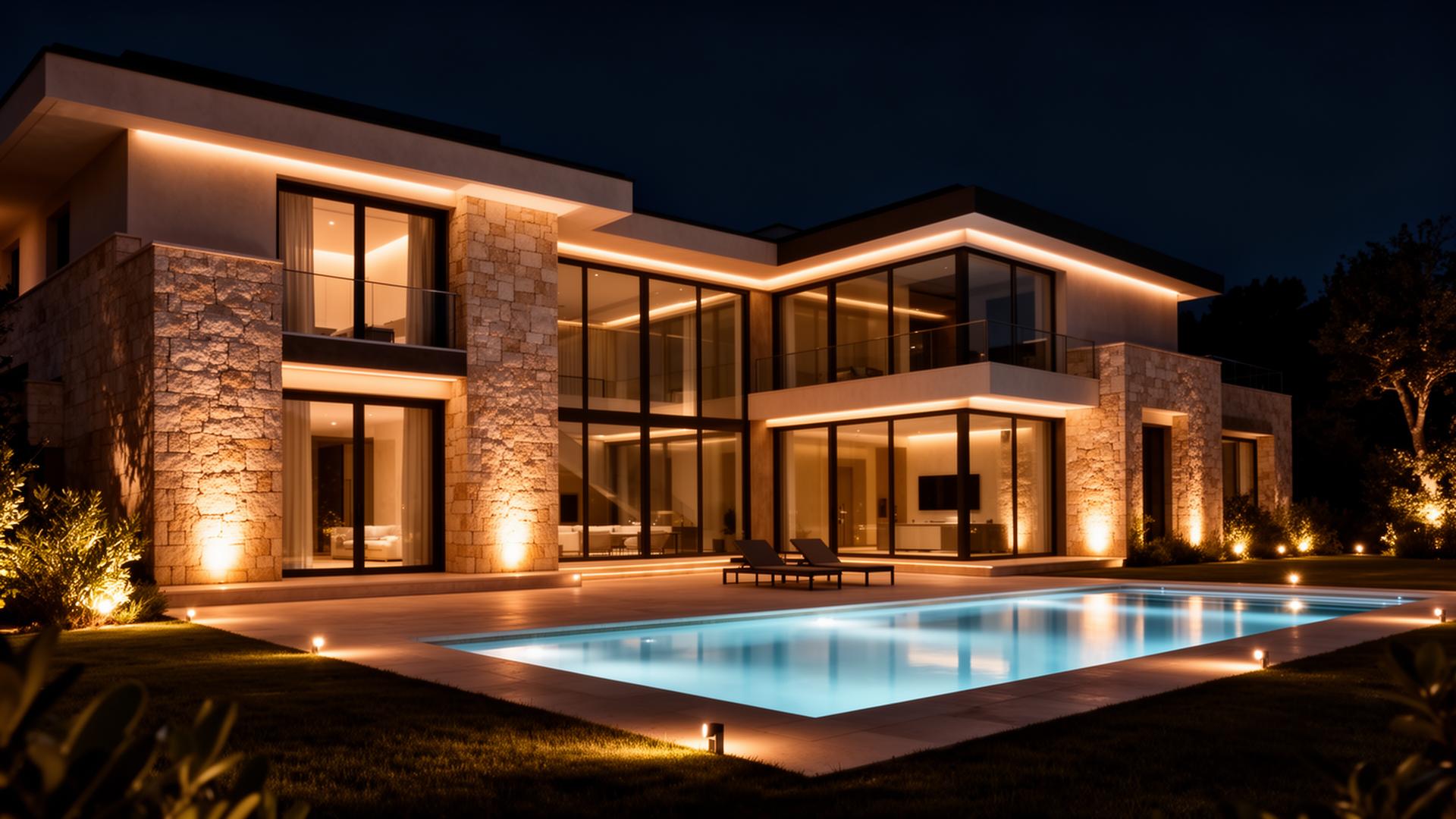
A villa landscape should not look like a miniature airport after sunset.
Rows of identical bollards, exposed uplights, glowing boundary walls and a floodlit lawn may make every corner visible, but they remove the mystery, depth and calm that make outdoor spaces enjoyable at night.
Landscape lighting should help people move, gather and see what matters. It should reveal the structure of planting, connect the building to the site and remain quiet enough for the night itself to survive.
In India, that visual objective has to be supported by practical decisions about monsoon water, soil, insects, heat, dust, plant growth, maintenance access and product serviceability. A beautiful concept that fails after one rainy season is not good landscape lighting.
Begin with the night experience, not the fixture list
Walk through the site in sequence.
Where does a person first arrive? Which route is used every day? Where are level changes? Which outdoor spaces are used for dining, conversation, prayer, play or events? What is visible from the living room, bedroom and driveway? Which parts of the site should remain dark for privacy?
This creates a hierarchy.
A typical villa or farmhouse landscape may include:
- Gate and address
- Driveway
- Pedestrian entry
- Main path
- Porch and entrance
- Courtyard
- Lawn
- Trees and planting beds
- Outdoor dining
- Pool or water feature
- Steps and retaining walls
- Sculpture or focal element
- Service routes
- Boundary and security areas
These areas do not need equal light. The everyday route and active outdoor rooms need clear support. A distant tree may need only a subtle presence. Service areas may need functional light that is separately controlled. Large parts of the landscape can remain dark.
Avoid the runway effect
Bollards are useful, but they are often overused.
A row of bright bollards at equal spacing can turn a garden path into an institutional walkway. The visible sources dominate the view, and the light often spreads into planting, windows and the night sky rather than staying on the path.
Path lighting can be created through several quieter methods:
- Shielded low-level bollards used only where needed
- Integrated light in a wall or step
- Concealed light beneath a bench or handrail
- Soft light reflected from a nearby wall
- Tree light that also creates enough ambient guidance
- Localised pools at turns and level changes
- Warm, downward light from a pergola or canopy
The entire route does not need uniform brightness in a private landscape. It needs legible continuity, safe changes in level and freedom from glare.
Light the structure of planting
Plants are not flat objects. Their branching, leaf density, movement and seasonal change determine how they respond to light.
A palm, rain tree, frangipani, bamboo screen, sculpted shrub and dense hedge all need different treatment.
Trees with expressive trunks or branches
A controlled uplight can reveal the trunk and canopy structure. The fixture should be positioned to avoid a single overbright patch and should remain out of normal sightlines.
Dense foliage
Front light may create a flat green mass. Backlight or side light can reveal depth and leaf edges. The final effect changes as the plant grows.
Fine foliage and grasses
Low side light can create movement and texture, but a visible source can cause glare. These plants may also move into the beam and require periodic adjustment.
Hedges and boundary planting
Uniform lighting can make a hedge look like a bright wall. Selective light may create greater depth and reduce spill toward neighbours.
Feature trees
A feature tree should be chosen because it has night-time value, not because every tree must receive a light. The strongest composition may illuminate one important tree and leave the surrounding canopy as a dark frame.
Planting plans and lighting plans should be coordinated. Fixture positions must account for roots, irrigation, future trunk diameter and maintenance equipment.
Learn more about garden lighting.
Design views from inside the house
Landscape lighting is often experienced through glass.
From a living room or bedroom, a lit tree can extend the perceived depth of the interior. A softly illuminated courtyard wall can become part of the room. A dark exterior, however, may turn the glazing into a mirror and reflect every bright interior source.
The exterior scene should therefore be reviewed from key indoor positions.
Ask:
- Is the main view supported after sunset?
- Are any exterior fixtures visible through the glass?
- Does the landscape light compete with television or bedroom use?
- Is the interior so bright that the view disappears?
- Does a facade or tree light enter a bedroom?
- Are reflections of linear profiles or downlights visible in the glazing?
The building and landscape scenes should be balanced together, especially in homes with large glass openings.
Outdoor rooms need layered light too
A patio, deck, gazebo or poolside area should not depend on one central ceiling fixture.
Outdoor dining needs light on the table and faces. A conversation area needs softer ambient and vertical light. A barbecue or outdoor kitchen needs task light. A pergola may carry integrated light, decorative light or both. Steps and circulation need separate guidance.
A useful outdoor room may combine:
- Warm table or pendant light
- Shielded downlight from a structure
- Soft light on a wall or planting edge
- Task light at cooking or serving surfaces
- Low-level light for movement
- A distant lit landscape element to create depth
The layers should be independently controlled. The scene for a family dinner should not require every tree and boundary wall to be fully illuminated.
Learn more about landscape lighting techniques.
Be careful around water
Pools and water features can create beautiful reflections, but they also introduce safety and technical risk.
Underwater light should be coordinated with the pool finish, geometry, water clarity and viewing direction. Bright sources facing the user can create glare. Uneven placement can reveal every construction imperfection. A water feature may need light on moving water, the receiving surface or the surrounding material rather than a visible lamp under the water.
Electrical safety, equipment ratings, isolation, earthing and local code compliance must be handled by qualified professionals. Access for replacement should be considered before the pool or water body is completed.
Reflected light can often do more than high output. Water already creates movement. It does not need to become the brightest object on the property.
Learn more about pool lighting.
Warm light usually belongs better outdoors at home
Residential landscapes generally benefit from warm-coloured light because it feels calmer, works well with many natural materials and reduces the visual harshness of the installation.
That does not mean every fixture should automatically be 3000K. Some planting, stone or contemporary architectural materials may respond differently. Consistency across visible sources is more important than choosing a number in isolation.
Avoid mixing several colour temperatures without a clear reason. A warm pathway beside a cool-white tree and a green-tinted facade can make the site feel fragmented.
Also review colour quality. Leaves, flowers, food, skin tones and timber should not appear dull or distorted.
Use darkness as a boundary
Lighting every edge of a large farmhouse can make the property feel smaller.
When the boundary is continuously bright, the eye immediately understands the full extent of the site. Selective lighting can create layers, with foreground, mid-ground and distant elements appearing gradually.
Darkness can also protect privacy and reduce disturbance to neighbouring land.
Security lighting should be designed as a separate requirement. It may use cameras, sensors and focused coverage in selected zones rather than keeping the entire landscape at high brightness all night. The security strategy should not destroy the residential night scene.
Indian weather changes the technical detail
Outdoor fixtures in India may face intense sun, monsoon rain, humidity, dust, insects, irrigation water, soil chemicals and accidental impact from gardening equipment.
A catalogue IP rating alone is not enough.
The complete installation should consider:
Drainage
An in-ground luminaire should not sit in a water pocket. Provide proper drainage material and detail the surrounding surface so water does not collect around the fixture.
Cable joints
Poor underground joints are a frequent failure point. Use appropriate waterproof connection systems and keep junctions accessible where possible.
Driver location
Drivers need ventilation, protection and access. Hiding them inside sealed landscape boxes or inaccessible planters can reduce life and make service difficult.
Heat
Dark metal housings in direct sun can become very hot. Thermal conditions affect LEDs, seals, drivers and surface safety.
Insects and dust
Openings, vents and poorly sealed components can collect insects and dirt. This affects output, appearance and maintenance.
Corrosion
Coastal or chemically aggressive environments need suitable materials and finishes. Fasteners, brackets and cable glands matter as much as the body of the luminaire.
Impact and gardening
Fixtures near lawns and beds may be hit by trimmers, hoses, tools or vehicles. Position and protection should reflect actual maintenance practices.
Serviceability
A fixture under mature planting may become impossible to reach. Access must be planned before the landscape fills in.
The strongest specification is not always the most expensive fitting. It is the fitting and detail that can survive the real site.
Plan for plant growth
A landscape is unfinished on the day of handover.
Trees expand, hedges thicken, groundcover spreads and branches move into beams. A fixture aimed at a young tree may illuminate only the lower trunk after five years. A hidden uplight may be swallowed by planting. Roots may push against housings and cables.
Design for adjustment.
Use accessible aiming, sensible cable slack, durable mounting and a maintenance plan that includes periodic review. Some fixtures may need relocation as the landscape matures.
The night composition should be expected to evolve.
Controls should follow use and time
Outdoor lighting is one of the easiest systems to leave on unnecessarily.
A good control strategy may include:
- Astronomical time clock
- Sunset activation
- Separate arrival, garden and outdoor-dining scenes
- Late-night dimming
- Motion control in service or security zones
- Manual override for events
- Pool and water-feature control
- Seasonal timing adjustment
- An all-off function from inside the home
The late-night scene should retain safe access and a quiet visual identity while switching off non-essential accent lighting.
This reduces energy, extends equipment life and protects the night environment.
Follow responsible outdoor-lighting principles
A useful framework is simple:
- Useful: Every light should have a purpose.
- Targeted: The beam should stay on the intended surface.
- Low level: Use no more light than the task requires.
- Controlled: Dim or switch off light when it is not needed.
- Warm-coloured: Limit short-wavelength light where possible and appropriate.
These principles do not restrict creativity. They remove visual waste.
A landscape often becomes more beautiful when the designer is forced to choose what deserves light.
Learn more about outdoor lighting mistakes.
A practical design sequence
- Map circulation, use, views and safety.
- Identify the night-time hierarchy.
- Coordinate planting, architecture and irrigation.
- Select lighting methods before selecting products.
- Build a control and circuit strategy.
- Review photometry, glare and spill.
- Detail mounting, drainage, cabling and access.
- Test critical trees, walls and water features on site.
- Aim and balance the installation after dark.
- Record settings and create a maintenance plan.
Landscape lighting cannot be fully commissioned during the day. Final aiming should happen after sunset, with the actual planting and surrounding lights visible.
Learn more about landscape lighting services.
The best garden lighting does not announce itself
You should see the path, not a row of lamps.
You should notice the tree, not the uplight buried beside it.
You should feel that the outdoor room extends naturally from the house, not that the garden has been decorated with electrical objects.
That quietness is difficult to achieve, but it is what makes a villa or farmhouse landscape feel considered at night.
Planning landscape lighting for a villa, farmhouse or resort?
Ashwamedha Design Solutions develops the night-time hierarchy, fixture strategy, technical details, controls, calculations, coordination and site aiming needed to create an outdoor environment that is beautiful, safe and maintainable in Indian conditions.
start a consultationFrequently asked questions
What is landscape lighting design?
Landscape lighting design is the planning of light for outdoor spaces — gardens, pathways, planting, water features, boundary walls and exterior architecture. It supports safe movement, reveals the landscape at night and connects the building to its surroundings through a considered lighting strategy.
What IP rating is required for landscape lighting fixtures in India?
Outdoor landscape fixtures require a minimum IP65 rating for ground-level and exposed installations. Submerged fixtures for water features require IP68. In areas with seasonal monsoon exposure or high humidity, higher IP ratings and corrosion-resistant materials are recommended.
How is landscape lighting different from facade lighting?
Landscape lighting supports movement, planting, outdoor use and the relationship between the building and its grounds. Facade lighting reveals the building itself — its form, texture and architectural character. Both should be designed together so they read as a coherent night-time composition.
What maintenance does landscape lighting require in India?
Landscape lighting in India requires regular cleaning of fixture lenses, inspection of IP seals before and after monsoon season, checking of cable glands and entry points, replacement of lamps or drivers on schedule, and periodic cleaning of ground-recessed fixtures to prevent silt blockage.
Who designs landscape lighting for villas and farmhouses in India?
Ashwamedha Design Solutions provides landscape lighting design for villas, farmhouses and private residences across India from our offices in Bangalore and Dehradun. Our work covers concept, photometric layout, fixture specification, BOQ and site supervision.