Design perspectives
How Lighting Design Is Different in India and International Projects
The physics of light does not change when a project crosses a border. The project conditions do, from daylight and climate to codes, product data, controls and maintenance.
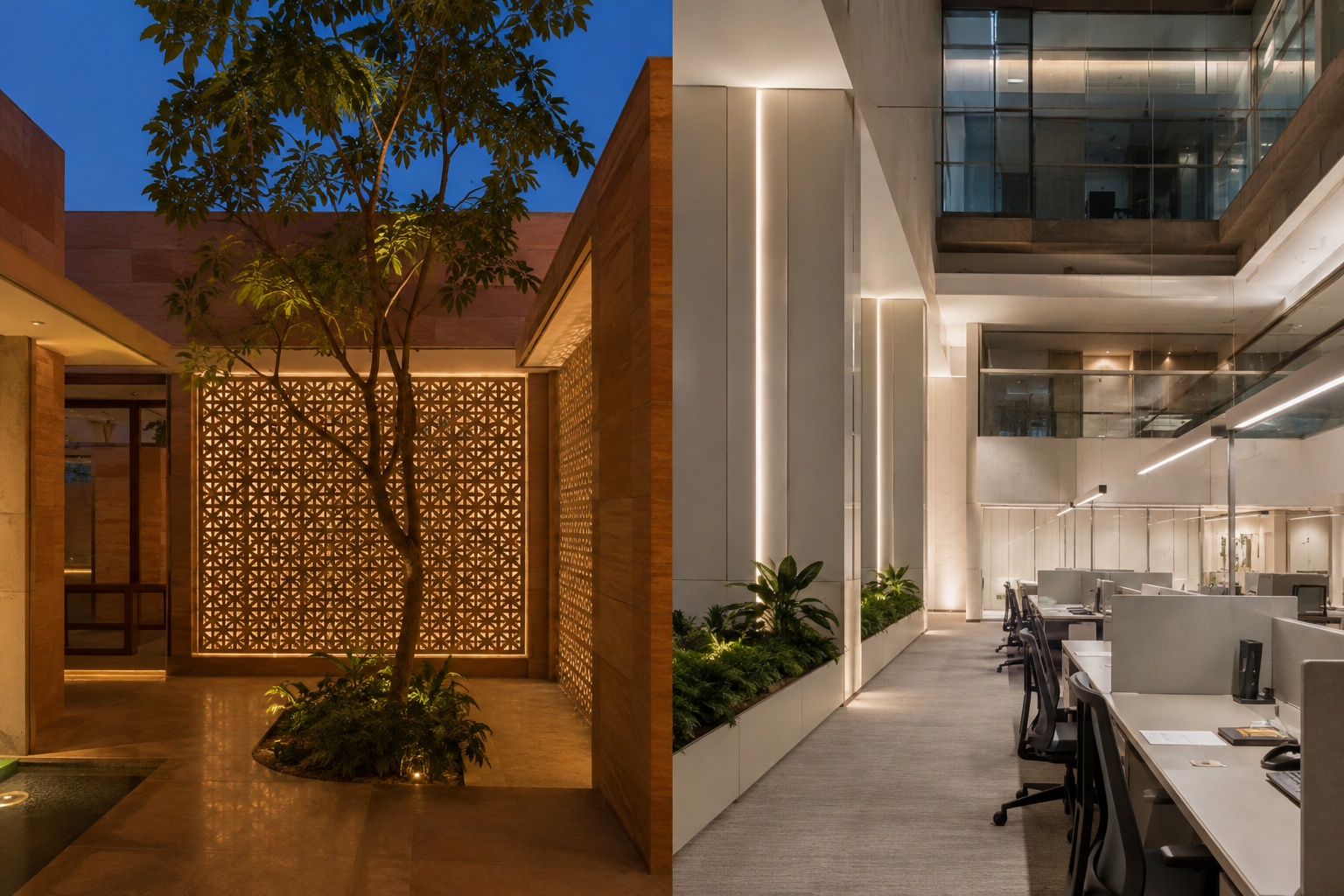
The physics of light does not change when a project crosses a border.
The project conditions do.
A beam still spreads according to its optic. A dark material still absorbs more light than a pale one. Glare is still glare. Human eyes still need adaptation, contrast and visual comfort.
What changes is the framework around the design: climate, daylight, construction practice, standards, procurement, electrical systems, cultural expectations, maintenance and the way a building is operated.
This is why "international lighting" should not mean copying a European reference image into an Indian project. Good lighting is not imported as a style. It is developed from context.
Standards and code frameworks vary
Every project should begin by identifying the standards, codes and authority requirements that actually apply.
In India, relevant references may include the National Building Code, Bureau of Indian Standards publications, state or local requirements, the Energy Conservation Building Code for applicable commercial projects and client-specific sustainability criteria.
IS 3646 (Part 1):2025 provides current general requirements and recommendations for working interiors. The Bureau of Energy Efficiency's ECBC framework addresses energy-efficient design for applicable commercial buildings, including lighting power and control provisions.
International projects may reference standards such as ISO/CIE 8995-1:2025, regional workplace standards, local energy codes, emergency-lighting requirements, accessibility rules, environmental-zone limits, WELL, LEED or client design guidelines.
The important difference is not simply the name of the standard. It is how early the requirement is confirmed, how clearly it is documented and how rigorously it is reviewed during design and commissioning.
Some jurisdictions demand extensive calculation, product certification and field verification. Other projects may rely more heavily on consultant documentation and client approval. A lighting designer must understand the actual compliance path instead of assuming that one global template applies everywhere.
Learn more about lighting standards.
India contains several lighting contexts, not one
It is easy to speak about "Indian conditions" as though the country has one climate and one construction culture.
It does not.
A coastal resort in Goa, a residence in Bengaluru, a commercial office in Delhi, a hotel in Jaipur and a mountain property in Uttarakhand face very different daylight, temperature, humidity, dust, corrosion, landscape and operating conditions.
Even within one city, a dense urban facade and a dark farmhouse site require completely different exterior-lighting strategies.
The design should respond to:
- Latitude and solar exposure
- Monsoon and drainage
- Coastal corrosion
- Dust and pollution
- Ambient temperature
- Surrounding night brightness
- Local vegetation
- Power and backup systems
- Maintenance capability
- Product service networks
International work requires the same contextual thinking. A project in Dubai, London, Singapore or a remote resort location should not receive the same specification simply because the drawings look similar.
Daylight can be abundant and still difficult
Many Indian projects receive strong daylight for significant parts of the year.
That does not automatically make daylighting easy.
High exterior brightness can create deep contrast between windows and interiors. Direct sun can cause glare and heat. Blinds may remain closed for long periods. Deep floor plates may still require electric light throughout the day. Reflective stone and glass can intensify discomfort.
The lighting design has to coordinate with architecture:
- Orientation
- Window size
- Glazing
- External shading
- Light shelves
- Interior reflectance
- Desk and screen position
- Blind control
- Daylight sensors
- Electric-light zoning
In some international markets, daylight simulation and performance targets are embedded early in the design process. In India, daylight may be acknowledged architecturally but not always connected to lighting controls and operational planning.
The opportunity is not to imitate the documentation. It is to integrate daylight and electric light more deliberately.
Material palettes change the lighting response
Indian interiors and facades often use stone, timber, metal, textured plaster, patterned screens, polished floors, rich fabrics and decorative craft in combinations that demand careful lighting.
A generic luminaire schedule cannot predict how all of these surfaces will behave.
For example:
- Polished stone may reflect a linear source clearly.
- Dark timber may need more controlled light than a pale render.
- Handcrafted texture may become beautiful under grazing light or reveal every installation irregularity.
- Jaali and screens can create depth through backlight, but exposed sources can destroy the effect.
- Brass and metallic finishes can produce intense highlights.
- Coloured fabrics and art need dependable colour quality.
International projects also use complex materials, but the local product and mock-up process may be more standardised in some markets. In India, physical review becomes especially valuable when material variation and site execution are high.
The correct response is not more light. It is better testing.
Product data quality and substitution risk vary
A lighting design depends on reliable technical information.
The ideal product submission includes accurate photometric files, dimensions, optical data, colour information, driver specifications, dimming details, ingress protection, thermal limits and certification.
In practice, the quality and consistency of this data can vary widely across manufacturers and markets.
On some international projects, approved-product processes, submittals and testing are tightly structured. On Indian projects, the design team may face a broader mix of premium manufacturers, capable local brands, imported products, assembled fittings and last-minute commercial substitutions.
This makes specification and technical evaluation critical.
A substitute should not be accepted because it has the same wattage and colour temperature. Review:
- Photometric distribution
- Intensity
- Beam quality
- Glare control
- Colour consistency
- Driver performance
- Dimming protocol
- Physical size
- Mounting detail
- Thermal performance
- Warranty
- Local service
- Long-term availability
A project can lose its lighting quality during procurement even when the drawings remain unchanged.
Learn more about DIALux simulations.
Cost engineering happens differently
Every market value-engineers.
The difference lies in when, how and against what criteria.
When cost reduction happens without a clear design hierarchy, essential optics and controls may be removed while visible decorative expenditure remains. A wall washer becomes a downlight. Two circuits become one. Dimming is removed. A high-quality driver is replaced. A facade mock-up is cancelled. The total fixture count may remain similar, but the performance changes completely.
A disciplined value-engineering process identifies:
- Which effects are essential
- Which layers can be simplified
- Where a local product performs genuinely well
- Which control functions protect everyday use
- Where fewer fixtures can be used through better optics
- Which decorative elements can carry more than one role
- Which details are too risky to compromise
International documentation often makes these performance criteria explicit. Indian projects benefit greatly when the same clarity is built into the consultant's drawings and specifications.
Electrical realities must be coordinated early
Lighting is sensitive to the quality of the electrical and control system.
Projects may include generator backup, inverters, UPS circuits, emergency supplies, voltage variation, surge conditions, phase-cut dimming, DALI, 0 to 10V, DMX, relay control or home automation.
The design needs to define:
- Which lights operate on backup
- What happens during transfer
- Whether drivers are compatible with the power condition
- Surge protection
- Dimming protocol
- Circuit load and grouping
- Emergency behaviour
- Restart state
- Control-network architecture
- Access to drivers and panels
In high-end international projects, controls may be designed and commissioned through specialist teams with detailed integration protocols. In India, a similar level of performance is possible, but responsibilities can become fragmented between electrical, automation, supplier and site teams.
A clear control intent and interface matrix prevents that fragmentation.
Maintenance changes the correct specification
A luminaire that is ideal in a city with strong service support may be a poor choice for a remote farmhouse or resort.
The designer must understand:
- Who will maintain the system
- How quickly spare parts can arrive
- Whether specialised access equipment is available
- Whether drivers and modules are replaceable
- How fixtures are cleaned
- Whether the control system has local support
- How staff turnover affects operation
- Whether the product will remain available
International projects sometimes have strict facilities standards and planned maintenance budgets. Other projects, anywhere in the world, may have limited technical support after handover.
The specification should match the operating reality, not only the opening-day visual.
Climate makes exterior details unforgiving
Indian exterior and landscape projects often face heavy rain, dust, insects, heat, irrigation and, in coastal locations, corrosion.
An IP rating does not solve the complete installation.
Drainage, cable joints, glands, mounting orientation, driver boxes, heat dissipation, surface temperature and maintenance access determine long-term performance.
Cold-climate international projects may face freeze-thaw cycles, snow, salt and different material movement. Hot desert projects may face extreme ambient temperature, sand and high surrounding brightness. Tropical projects face humidity, biological growth and intense rain.
The principle is universal: specify for the real environment, not a generic "outdoor" category.
Cultural use changes the scenes
A lighting scene is not only a technical setting. It reflects how the space is used.
Indian residences may accommodate large family gatherings, festivals, prayer, formal entertaining, live-in staff and strong indoor-outdoor use. Hospitality projects may transform between breakfast, events, weddings, dining and late-night operation. Commercial spaces may have extended hours and mixed occupancy patterns.
An imported control template may not understand these rhythms.
The design should ask:
- Who uses the space?
- At what times?
- How many people gather?
- Which activities are occasional but important?
- Who operates the controls?
- What is the cleaning routine?
- How is the building used during festivals or events?
- What happens during a power cut or backup mode?
International projects require the same cultural curiosity. A global designer should never assume that a typology operates identically in every region.
The approval and coordination process can change the outcome
Some projects have clearly defined stage submissions, coordinated BIM models, technical submittals and mock-up approvals. Others move quickly through calls, WhatsApp images, site decisions and changing drawings.
Neither process automatically guarantees quality.
Fast, informal coordination can be agile, but decisions need to be recorded. Formal documentation can be thorough, but it can also become disconnected from site reality.
For Indian projects, the lighting consultant often needs to bridge drawings and execution very actively. Site visits, sample reviews, marked-up photographs, coordination calls and after-dark aiming can be essential.
For international projects, remote coordination may require stronger digital documentation, clear assumptions, local installation partners and precise approval workflows.
The method should change. The design intent should not become vague.
Learn more about our process.
Mock-ups carry different weight, but they matter everywhere
A mock-up is one of the most effective ways to reduce lighting risk.
It can test:
- Facade material
- Cove detail
- Wall-washing setback
- Joinery integration
- Ceiling cut-out
- Decorative and architectural balance
- Colour temperature
- Dimming
- Glare
- Landscape aiming
- Control scene
Where workmanship and material variation are high, a mock-up exposes coordination issues early. Where documentation and specification are strict, it confirms that the constructed result matches the design.
The point is not to prove that the original idea was right. The point is to improve the final result.
International quality is a process, not an aesthetic
A project does not become international because it uses imported fixtures, cooler colour temperature, minimal lines or a famous control brand.
International-quality lighting is better understood as a process:
- Clear design intent
- Applicable standards
- Reliable calculations
- Complete specifications
- Coordinated details
- Transparent substitutions
- Physical testing
- Recorded approvals
- Proper commissioning
- Maintainable operation
India can produce work at this level, and often with exceptional material richness and spatial complexity. The challenge is to protect the process through procurement and execution.
Learn more about visual comfort.
Indian design should not be treated as a compromise
Contextual adaptation is not a lower standard.
Choosing a locally serviceable product, designing for monsoon drainage, creating scenes around family use or simplifying a control interface for the operating team can make the project better than a copied global specification.
Likewise, international work should not be reduced to unfamiliar codes. It is an opportunity to learn from different standards, construction systems and cultural expectations.
The lighting designer's responsibility is to preserve the quality of thought across both.
The best approach combines global discipline with local intelligence
Use global technical knowledge.
Respect local standards.
Understand the actual people, materials, climate, procurement and maintenance conditions.
Then design the light for that project.
The result should not look "Indian" or "international" as a borrowed style. It should feel precise, comfortable and inevitable in its own context.
Learn more about about Ashwamedha.
Planning a project in India or coordinating one across countries?
Ashwamedha Design Solutions develops architectural lighting through context, standards, calculations, specifications, controls, coordination and site reality. The design is adapted to the project without lowering the visual or technical ambition.
start a consultationFrequently asked questions
What lighting standards apply to projects in India?
India does not have a single mandatory national lighting standard equivalent to EN 12464-1 or CIBSE. Projects typically reference NBC (National Building Code), BIS standards, GRIHA or IGBC green building requirements and in many cases international standards such as CIBSE or EN by client or consultant specification.
How is lighting design different in India compared to Europe?
Key differences include daylight abundance and intensity, a much wider range of material palettes and finishes, varying product data quality and substitution risk, different electrical infrastructure, climate conditions that affect exterior and IP specification, and procurement and cost engineering practices that happen differently on site.
What is the biggest substitution risk in lighting projects in India?
The most significant substitution risk is when a lower-cost alternative is compared to the specified product on wattage and price alone, without checking photometric performance, CRI, CCT, beam distribution, driver compatibility or IP rating. This leads to a visual result that differs significantly from what was designed.
Can international lighting standards be applied to Indian projects?
Yes. CIBSE, EN 12464-1 and WELL v2 are regularly applied to Indian commercial, hospitality and residential projects — particularly those with international clients or green building certification requirements. The design process follows international standards while adapting to local materials, procurement and site conditions.
Who has experience with both Indian and international lighting projects?
Ashwamedha Design Solutions, founded by Srikrishna Ellore, has experience across lighting projects in India and internationally. Our practice applies international technical standards to Indian project conditions across residential, commercial, hospitality and facade typologies.